



Testing the Limits of Diversity in Tech

Keith McIntosh has always thrived on testing limits and pushing boundaries.

I was delighted to have him as my guest on episode 25 of the TechTalks Podcast. We talk about his path from growing up in Carleton Country to founder of PLATO, the world’s first Aboriginal-led and staffed software testing company, and president and CEO of PQA, one of New Brunswick’s first software testing companies.

We cover a lot of ground, from his evolution as an entrepreneur to his goal of simultaneously solving two pressing problems–Canada’s shortage of technology professionals and high unemployment among Indigenous youth.

We started in his early days on a farm in Glassville, NB, which Keith says was a great training ground for his future career path. “It taught me a lot about hard work and about managing your money and entrepreneurship.”

And the small-town spirit of helping your neighbours has never left him.

“You understood that you weren’t on your own,” he says. “And that, as much as anything, reflects in what I've done with PQA and PLATO.” 

Getting to Testing

After high school, Keith took some computer science courses at UNB, then worked GIS-related roles at Irving and CARIS, where he got his first exposure to testing, which suited him better than programming. 

“My mother would have said I’m a born tester; I was always finding a boundary to push,” Keith quips. The job is all about finding the weaknesses in a piece of software or product glitches.

“I see testers as advocates for the customer,” Keith says, working between the end-user and the developers to build the best product. The role requires equal measures of technical savvy and diplomacy.   

In the mid-90s, he founded Professional Quality Assurance (PQA). It was an auspicious time, with New Brunswick riding high from the heady McKenna-era growth of the contact industry and related tech sectors. Plus, the Y2K scare approaching with the turn of the century was driving business in testing.

Keith tells how PQA grew from hiring friends to expanding to what is today a team of 100-plus software testing specialists across Canada that help clients speed up release cycles and reduce critical bugs. In 2004, they landed a contract with Apple, which was launching new software and hardware. Keith’s team would receive unmarked gray boxes from Apple with no labels or markings that they opened in a secure room.  

In the 2010s, they grew west, acquiring rallyQA in Vancouver and expanding to Calgary.

The Seeds of PLATO

In 2015, Keith took part in the Governor General's Canadian Leadership Conference. The two-week tour brings together a diverse group of 250 people from across Canada.

“The only thing they have in common is their type-A personalities,” Keith says.

The tour included a visit to a First Nation in sight of the Montreal skyline, where the stench of the water was overwhelming.

“As a Canadian, as a human being, that's just wrong,” Keith says. “So, we were talking about how do we fix it?”

It was the same year that the Truth and Reconciliation Commission’s Report was released.

“The report was saying businesses have to help with reconciliation,” he says. “At the same time in New Brunswick, we were talking about an aging, migrating population.”

Keith connected the two, realizing he could do something about it. He saw a “perfect union” between his industry, which was hungry for talent, his province that needed to grow its population and economy, and Aboriginal people who needed opportunities.

“Why don’t we just hire them?” he thought.

And PLATO Testing was born.

Training AND Jobs

Keith quickly learned that it’s not that simple. Without training, Indigenous people weren’t ready for roles as software testers because they didn’t have the skills. So PLATO came up with a plan to build a training course in software testing.

From an idea in June, by September 2015, he’d launched the first class.

“I was so lucky, so shouldn't you give that back?” he says. “Why am I lucky? It's because somebody took care of me or did something for me. PLATO is my chance to do something, to change lives.”

As PLATO’s grown, Keith and his team have learned it can’t be a one-size-fits-all program. 

“Each First Nation is unique. It has its own challenges, history and desires,” he says. And the people that come into his program are not homogenous, he says. “They have individual challenges, individual problems. And so you need to be small enough and nimble enough to deal with each community.”

Beyond training, PLATO is focused on connecting people to jobs. From the beginning of PLATO, Keith was also thinking about attracting people to work for PQA.

“Because we're a testing company, and nobody goes to school to be a tester,” he says.

For people in marginalized communities, it’s not enough just to provide skills. They may need additional support to succeed.

“It's opening that first door,” Keith says, “and sometimes taking them by the hand and pulling them through the door.”

So PLATO acts as a bridge to corporate Canada, helping employers make the necessary adjustments.

“You can't just change somebody; you also have to change the work environment,” he says. “You can't say, ‘I'm going to take a square peg and fit into a round hole.’ Sure, I can shave some of the edges off of the square peg. But maybe I have to widen the hole a little bit, too. So it's both sides.”

At the core of PLATO’s values is diversity.

“It's important to have diversity everywhere, but especially in technology, because different viewpoints matter,” he says. “People have different skillsets and upbringings and ways of looking at things. It just makes the world better.”

It’s those organizations that diversify their teams that will prevail. And there’s the critical social justice element, as well. As Keith says, “Companies are either going to be on the right side of history, or they're going to be history.”

The Future Looks Bright

PQA and PLATO combined have over 170 employees, providing diverse software testing solutions to clients throughout North America, and Keith sees an opportunity to grow to 500 or even 1,000 employees.

He also sees potential to expand the train-and-incubate model beyond testing to development, network support and more.

Now, with locations in eight cities across Canada, PLATO is looking to grow beyond urban centres, taking its program to rural communities, so people don’t have to leave home for work and communities don’t lose leaders and talent.

“Technology is the one thing that we can take anywhere,” Keith says. He believes that along with clean drinking water, universal broadband access should be a top priority for all First Nations.

“Not only does it bring opportunities to these communities, but it also brings learning, it broadens horizons.”

I am so inspired by the work Keith is doing to grow our industry, increase its diversity and broaden the horizons of Aboriginal youth. To check out our entire conversation, click here to listen. 

Keith McIntosh.png

Here's a peek at some of the highlights from this episode:

  • [02:28]: We start by talking about Keith’s early days, growing up on a farm in Carleton County.

  • [11:18]: Keith describes the tester’s role in software development.

  • [25:23]: Keith shares his experience of racism and how that’s shaped him.

  • [30:02]: We chart PLATO’s growth trajectory across Canada.

  • [42:21]: Keith on why we need to keep “peeling the onion” of identifying problems and solutions.

Don't Miss an Episode.

Do you subscribe to the TechTalks with Cathy Simpson Podcast? If not, please do. Every week, my guests and I cover many different topics around innovation, technology and the future. Click here to listen and subscribe in iTunes. You'll find us on Spotify, Apple Podcasts, Google Podcasts, PodLink and everywhere else you enjoy podcasts.

And sign up for our newsletter to never miss an update.
The Road to a Record Investment

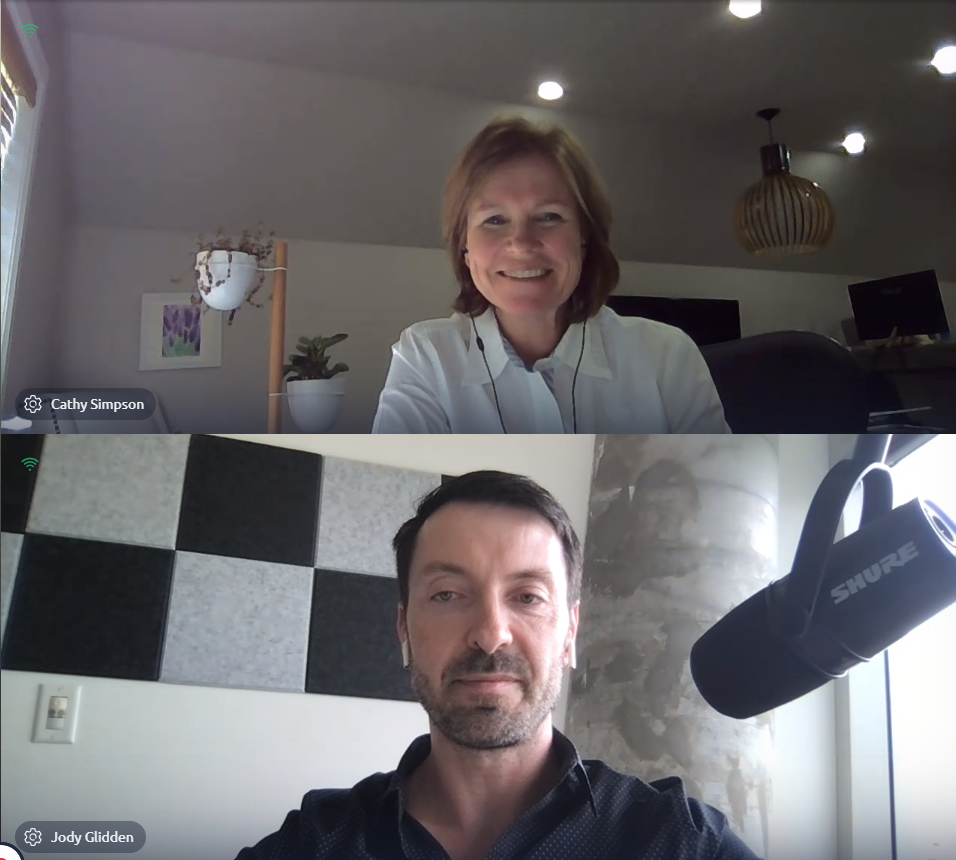
Jody Glidden’s a lifelong entrepreneur. As a kid, he capitalized on the Bruce Lee rage, making nunchucks from broomsticks in his dad’s workshop that he sold to schoolmates. One day, there was a knock on the door.

“It was the police who said to my mother, ‘Do you realize your son is selling weapons at school?’ I hadn't really thought of it that way,” Jody says from Miami, where he lives. “But that was the end of my first business.”

He’s come a long way from those early days in Miramichi. As my guest on episode 24 of the TechTalks podcast, Jody shares his story, charting the path to his post as CEO of Introhive. The New Brunswick CRM software company recently raised a record $100 million US in funding for the largest equity investment in the province’s history.


A Winding Road

Jody’s path was a crooked one. An early computer enthusiast, he started programming in elementary school. After graduation, struggling at UNB where he was taking computer science, he got busy getting a record number of Microsoft certifications. This caught the attention of the founders of Scholars.com, a Fredericton company that built one of the world's first large-scale collaborative web software products.

At Scholars, Jody oversaw a large and growing technical team. His star was rising, but, by the time the company was acquired, he wanted more.

“I remember at the time feeling like that wasn't enough,” he says. “Why don't I have my own company?”

He was 22 or 23.

Looking back, “it seems ridiculous that at that age I felt like that wasn't enough,” he says. But he was young and confident, and he pushed onward. He started his own company, icGlobal, which exposed him to other sides of the business: finance, accounting, HR, and, especially, sales, from pipeline management to prospecting.

This shift from the development side of things to leading and growing a company was its own education in how to be a CEO that would serve him well.


Go West, Young Man

When icGlobal was acquired, Jody relocated to San Francisco, where he got his first taste of Silicon Valley.

By his late 20s, he decided it was time to head back to school. After getting his BBA back at UNB, he then enrolled in Harvard’s Master’s in Management Information Systems, which teaches a mix of software engineering and software management practices. At the same time, he joined the sales team at Chalk Media to gain practical experience.  Jumping into a sales role was not the expected path most would have expected Jody to take.

“And, oh my god, that job was hard,” Jody says. “It was way harder than I expected. You're just getting hung up on constantly.”

He kept at it, ultimately getting promoted to COO and CTO, the role he held when it was sold to Blackberry, where Jody eventually found himself reporting directly to Jim Balsillie. 

Through all the shifts in his career, tenacity and perseverance are the enduring themes in Jody’s story.

“I feel like if you put in the effort that 99% of people won't do, then you might have a shot at the rewards that 1% of people get.”


The Introhive Buzz

When he was at Blackberry, Jody started to see a big opportunity in optimizing sales.

“I always kept this little book with different ideas for what my next startup might be,” he says. “At a certain point, l just thought the time was right to go after this category.”

Jody co-founded Introhive in Fredericton in 2012. He’d come back to New Brunswick for the software talent, bringing everything he’d learned along the way about sales, and the gaps in the CRM software market, with him.

Today, Introhive has more than 300 staff, more than half in its Atlantic Canadian offices in Saint John, Fredericton and Halifax, the rest in London, Miami, Chicago, San Francisco and Toronto. Its software is used in some 90 countries, a ten-fold increase from just two years ago. Introhive’s key differentiator–an uncommon focus on customer retention and client happiness–is fueling its expansion.

“We call our formula the three Rs: revenue, retention and relationships,” Jody says. “If you have all three of those dialed in, you're going to drive revenue to a level that you couldn't before.”


Going Big

Introhive has successfully fundraised in the past, but for its latest Series C round, the stakes were so high they decided to work with an investment bank. They chose Bank of America, which helped Introhive hone its story, which it circulated to potential investors.

“There was silence for about two weeks,” Jody says. “We wondered if they were actually doing anything.”

They were.

The meetings began soon after with potential investors, with Introhive ultimately choosing Providence Strategic Growth as its lead investor. There’s some local money in the $100-million mix, too, from the New Brunswick Innovation Foundation (NBIF), as well as the BDC.

“I was really happy to get the support of some Canadian investors,” Jody says, “because I really think Canada should be a part of this story going forward, not just in the past.”

The new money will fuel small acquisitions and new hires in sales, marketing and engineering.

“We're trying to figure out the fastest we can grow organically,” he says. And that takes money–and big thinking.

Jody uses a thought exercise he learned from Marcel LeBrun, a New Brunswick tech sector leader: instead of aiming for, say, doubling growth, think: what is stopping us from getting to five times growth?

“By setting the bar really high, it brings those points out,” Jody says. “It makes it more obvious so you know what problems you should look at.”

Setting the bar high is nothing new to Jody. He’s leading by example, showing what can happen en route from Miramichi to Silicon Valley, Boston, Miami and beyond, but always with one foot firmly planted here in New Brunswick.

As Jody says, the software business is limitless, unconstrained by the supply chain and geography.

“That's why tech companies are some of the fastest-growing in the world, because they're the most scalable,” Jody says. “And that just creates a lot of fun.”

Fun indeed! To check out our entire conversation, click here to listen.

Here's a peek at some of the highlights from this episode:

  • [05:28]: We start by talking about Jody’s early ventures as a kid in Miramichi.  

  • [18:00]: Jody talks about the real-world learning of starting his own company.  

  • [31:34]: Chalk Media and Jody’s crash course in sales.  

  • [37:08]: We talk about what it takes to rise to the top.  

  • [43:45]: Jody on the talent pool in Fredericton and New Brunswick’s advantages.  

  • [54:46]: Jody’s history of pitching to investors and what he’s learned along the way.  

Don't Miss an Episode.

Do you subscribe to the TechTalks With Cathy Simpson Podcast? If not, please do. Every week, my guests and I cover many different topics around innovation, technology and the future. Click here to listen and subscribe in iTunes. You'll find us on Spotify, Apple Podcasts, Google Podcasts, PodLink and everywhere else you enjoy podcasts.

And sign up for our newsletter to never miss an update.

Gestionnaire de programme – Digital Boost 2.0

DigitalBoost2-logo.png
 
  • Plein temps

  • À distance (dans les limites du Nouveau-Brunswick)

  • Poste contractuel de 10 mois

  • Une expérience dans l'industrie des technologies de l'information ou en gestion est un atout. Les nouveaux diplômés sont les bienvenus pour postuler. 

  • Être parfaitement bilingue (français et anglais) est essentiel

  • Rémunération selon l’expérience  

Contribuer à faire progresser la transformation numérique au Nouveau-Brunswick

Le/la gestionnaire de programme veille au bon déroulement des activités quotidiennes et générales du Programme de Digital Boost 2.0, le programme le plus ambitieux à ce jour de TechImpact. Le Programme de Digital Boost 2.0 permettra à 150 entreprises du Nouveau-Brunswick d’obtenir du financement et de l’expertise pour effectuer un premier pas ou adopter une nouvelle approche dans leur parcours vers leur transformation numérique. Si vous êtes une personne bilingue pleine d’initiative et que vous souhaitez mettre votre expérience à profit dans le domaine des technologies pour aider les entreprises du Canada atlantique à se développer et à prospérer, ce rôle polyvalent est peut-être pour vous.

Principales responsabilités

Le/la gestionnaire de programme a la responsabilité d’assurer le bon déroulement du Programme de Digital Boost 2.0 à chacune des étapes. Ce poste demande essentiellement de travailler avec les demandeurs de langue française et d’être en étroite collaboration avec l’autre gestionnaire du Programme de Digital Boost 2.0. Les principales responsabilités incluent :

  • La gestion des intervenants (demandeurs, comité de révision, bailleur de fonds) pour veiller à ce que tous les intervenants s’acquittent de leurs responsabilités afin de favoriser le bon fonctionnement du programme

  • Leadership/responsabilisation envers le programme : garder une bonne vision d’ensemble du programme

  • Surveiller les paramètres de réussite des projets et élaborer des plans pour y parvenir (marketing/efforts de communication)

  • Faire régulièrement rapport au PDG de TechImpact sur le statut du programme

  • Évaluer la structure du programme et offrir des suggestions pour l’améliorer

  • Profiter des apprentissages qui découlent du programme  

Demandes commerciales

  • Traiter toutes les demandes commerciales en les mesurant à certaines compétences prédéterminées

  • Assurer le processus de traitement des demandes et veiller au flux régulier des communications

  • Travailler avec le comité de révision pour son avis et traiter toutes les communications des demandeurs  

  • Assurer un soutien aux entreprises dans leur parcours du programme 

  • Examiner le matériel de soutien (énoncé des travaux, plan de réalisation, etc.)

Demandes des fournisseurs

  • Traiter toutes les demandes de fournisseurs de technologie

  • Assurer le de traitement des demandes des fournisseurs vers le processus de révision, en collaboration avec le comité de révision pour son avis et fournir des communications

  • Assurer un soutien aux fournisseurs de technologie sélectionnés dans le cadre du programme

Compétences

  • 3+ années d’expérience au sein de l’industrie de la technologie, de préférence dans les services de TI, serait un atout significatif

  • Expérience de l’utilisation de HubSpot est un atout

  • Bonne connaissance de la transformation numérique et du développement des stratégies et feuilles de route techniques/numériques  

  • Solides compétences en communication (à l’oral et à l’écrit)

  • Expérience du service à la clientèle

  • Faire preuve d’adaptabilité et de polyvalence

  • Faire preuve d’initiative

  • Solides aptitudes organisationnelles

  • Passion pour le Canada atlantique

  • Capacité de communiquer à l’oral et à l’écrit, en français et en anglais, est un atout essentiel

Comment faire une demande

Prière d’envoyer une lettre de présentation et votre curriculum vitae à cathy.simpson@techimpact.it au plus tard le 16 mai 2021. 

À propos de TechImpact et du Programme de Digital Boost 2.0

TechImpact s’est donnée comme mission d’aider à accélérer l’adoption de technologies nouvelles et innovantes au Canada atlantique dans le but de promouvoir notre économie et la société humaine.  

C’est en partie ce que nous faisons grâce à des programmes stratégiques, comme le programme de Digital Boost 2.0, qui viennent combler les lacunes. Le programme de Digital Boost 2.0 aide les entreprises du Nouveau-Brunswick à effectuer leurs premiers pas dans leur parcours vers une transformation numérique. Le programme vise à les jumeler avec un fournisseur de technologie local afin d’élaborer une stratégie technique/numérique dans le but de rester concurrentiel, flexible et visionnaire à mesure que notre monde poursuit sa métamorphose vers le numérique.

Program Manager – Digital Boost 2.0

DigitalBoost2-logo.png
 
  • Full-Time

  • Remote (within New Brunswick)

  • 10-month contract position

  • IT industry or management experience is an asset. New graduates welcome to apply.

  • Fluently bilingual (English and French) a must

  • Pay dependent on experience

Help Advance Digital Transformation in New Brunswick 

The Digital Boost 2.0 Program Manager oversees day-to-day and overall operations of Digital Boost 2.0, TechImpact’s most ambitious program ever. DB 2.0 will give 150 New Brunswick companies funding and expertise to take the first step or a new approach on their digital transformation journey. If you’re a bilingual self-starter who wants to use your experience in the tech sector to help Atlantic Canadian companies grow and thrive, this challenging, diverse role may be for you.

Key Responsibilities  

The Program Manager is responsible for keeping Digital Boost 2.0 running smoothly at every stage. This position will work primarily with French applicants and will work closely with the other Digital Boost 2.0 Program Manager. Key responsibilities include:

  • Stakeholder management (applicants, review committee, funder) to ensure all stakeholders are meeting their responsibilities to keep the program running smoothly

  • Program leadership/ownership: maintaining a comprehensive view of the program

  • Monitoring project success metrics and developing plans to meet them (marketing/communication efforts)

  • Regularly reporting back to TechImpact CEO on the status of the program

  • Evaluating program structure and offering improvement suggestions

  • Capturing learnings of the program 

Business Applications

  • Processing all business applications, measuring them against predetermined qualifications

  • Moving applications through the process and ensuring a consistent communication flow

  • Working with the review committee for input and managing all applicant communications

  • Providing support to businesses as they go through the program

  • Reviewing supporting materials (Statement of Work, Implementation Plan, etc.)

Vendor Applications

  • Processing all technology vendor applications

  • Moving technology vendor applications through the review process, working with the review committee on input and providing communications

  • Providing support to technology vendors that are selected for the program

Qualifications

  • 3+ years of experience in the technology industry, preferably IT services, a significant asset

  • Experience using HubSpot an asset

  • Familiarity with digital transformation and development of digital /technical strategies and roadmaps

  • Strong communication skills (written and oral)

  • Customer service experience

  • Ability to be adaptable and versatile

  • Self-starter

  • Strong organization skills

  • Passion for Atlantic Canada

  • French and English speaking, written, and communications skills a must 

How to apply

Please send your cover letter and resume to cathy.simpson@techimpact.it by May 16, 2021. 


About TechImpact and Digital Boost 2.0

TechImpact is on a mission to help accelerate technology adoption and innovation in Atlantic Canada to elevate our economy and society.  

We do this in part through strategic programs, such as Digital Boost 2.0, that fill the gaps. Digital Boost 2.0 helps New Brunswick companies take the first step on their digital transformation journey. The program pairs them with a local technology provider to create a digital/technical strategy to remain competitive, resilient and forward-thinking as our world continues to digitize.

Introducing Digital Boost 2.0

It’s been a big month here at TechImpact, as we launch Digital Boost 2.0, our bold new program to drive technology adoption in small to medium-sized New Brunswick businesses.  Applications are being accepted starting April 21.

This project is possible thanks to $3.7 million from ACOA, the Atlantic Canada Opportunities Agency. This week on the TechTalks podcast, I’ve got two stellar staff members from ACOA on the show with me to dive into why this program specifically and digital adoption, in general, is so important.

Meet My Guests

First, let me introduce my guests, Kalie Hatt-Kilburn, Director General of Regional Operations, ACOA New Brunswick, and Trevor Macausland, an Economic Development Officer with ACOA’s Innovation, Trade and Business Growth team.

Ep. 23 group.png

Kalie and Trevor embody the best in the public service: deep industry knowledge, a passion for business, especially entrepreneurship, and years of hands-on experience in economic development.

“It is a tremendous place to work,” Kalie says. “It is full of people that are deeply committed to this region and seeing our companies prosper and our communities flourish.”

The COVID Context

We kicked off by talking out how ACOA, as a regional development agency, is a “very nimble tool for the federal government to be able to deliver responsive programming,” as Kalie says.

Of course, COVID-19 has necessitated the swiftest, most significant response of all. Companies struggled with the seismic shifts it brought to all facets of their operations while many were also dealing with revenue drops and worrying about survival.

As ACOA stepped up to help companies adapt and stabilize, the predominance of the need for digital and automation solutions was striking.

“We saw the opportunity to give a boost,” Kalie says. “And that's why we call this program Digital Boost, isn't it? To enable them to make that pivot sooner with some support, while also focusing on survival and sustainability.”

The Transformation Was Already Underway

ACOA had been looking at digital transformation for a while when COVID hit.

“Prior to the pandemic, we were already working internally to raise awareness of the benefits of leveraging technology in order to be more productive and efficient and increase the customer experience,” Trevor says.

COVID was an accelerant in making digital top-of-mind. Still, many businesses struggle to start the shift.

“They're trying to walk and chew gum at the same time,” Kalie says, “to make this transition while also keeping their companies going.”

And then there’s the challenge of where to turn for help.  “If you don't have that expertise in-house, it's a daunting prospect to see where do you start and how do you start?”

Enter Digital Boost 2.0

When it comes to digital adoption, there are risks to action as well as inaction. 

“If you don't have a plan of how you're going to proceed over time, then you can have some more random acts of digital or random acts of automation, and it doesn't knit together in a cohesive plan,” Kalie says.

DB 2.0 pairs businesses with qualified local Atlantic Canadian technology providers to create a digital strategy and roadmap, which creates a win-win for both the company and the technology provider.  Through the program, businesses can receive up to $20,000 to do this work or 75% of the costs (maximum of $26,600), with the businesses paying the remaining 25%. (To learn more or to apply, click here).

Here at TechImpact, we’re proud to leverage our knowledge and connections to be the trusted industry intermediary between government, companies and service provides. 

“The real critical piece is having some trust and faith in the expertise that you're accessing,” Kalie says.

The Big Picture

Digital Boost 2.0 will give businesses clarity and confidence in their digital journey by giving them a tailored plan to adopt things like automation and AI. Along with being more competitive, productive and better able to attract talent, there are other, bigger benefits, as well.

“What we're really looking at here is outcome transformation for these clients,” Trevor says. It’s a chance to examine their current and desired future states and bridge the gap. That means looking beyond just technology or software at skill sets, culture and people.

And for ACOA, the program is also a great chance to have informed conversations with clients to determine how to invest in the short-, medium- and long term, Trevor says, “to set them up to scale and grow and export and become more resilient in the new normal.”

The Collab Hub

When we launched the Digital Boost pilot project last year, we learned a lot. And one of the big messages from small and medium-sized businesses was that they know they need to adopt technology but struggled to find the right technical and digital help.

That’s how the Collab Hub (our working title for now) was born. We are in the early planning phases for this exciting project.  It’s an online platform and resource for non-tech businesses looking for local IT service providers. 

“It takes a village to raise a company,” Trevor says. “What we're trying to do is add more voices and more resources to it.” 

These are exciting times for our region and our industry, and, as my conversation with Kalie and Trevor shows, government has a huge role to play in accelerating our recovery. Check out our entire conversation by clicking here to listen.


And here are some of the highlights from this episode:

  • [05:48]: Kalie on ACOA’s dynamic, responsive role in supporting economic development. 

  • [17:13]:  Trevor describes ACOA’s interest in digital adoption even before the pandemic.   

  • [21:23]: Kalie talks about some of the challenges businesses face in digital transformation.

  • [25:42] Trevor on how DB 2.0 focuses on equipping companies with a digital roadmap.

  • [30:07]:  Kalie on TechImpact’s role in DB 2.0 as a trusted intermediary between funder, consultants and clients. 

  • [42:18]: Trevor on the need for a collaborative, online community connecting SMEs, service providers and businesses.

  • [44:21]: Kalie on how ACOA looks for ways to create and facilitate digital spaces where stakeholders can connect.


Don't Miss an Episode.

Do you subscribe to the TechTalks With Cathy Simpson Podcast? You should! Every week, my guests and I cover many different topics around innovation, technology and the future. Click here to listen and subscribe in iTunes. You'll find us on Spotify, Apple Podcasts, Google Podcasts, PodLink and everywhere else you enjoy podcasts.


And sign up for our newsletter to never miss an update.

TechImpact lance la version 2.0 du Programme de renforcement de l’infrastructure technologique pour accélérer l’adoption de nouvelles technologies au Nouveau-Brunswick

Une aide gouvernementale de plus de 3,7 millions de dollars permettra aux entreprises du Nouveau-Brunswick d’élaborer et de mettre en œuvre des feuilles de route numériques

Le 15 avril 2021 · Fredericton (Nouveau-Brunswick) · Agence de promotion économique du Canada atlantique (APECA)

L’innovation et la diversification contribuent à la croissance de l’économie et à la création de bons emplois pour la population du Canada atlantique. Afin de favoriser le développement et la croissance d’une économie durable, les entreprises de la région doivent continuer à mettre en place les technologies innovatrices, les projets et les processus qui améliorent leur productivité dans le respect de l’environnement.

TechImpact launches Digital Boost 2.0 to drive tech adoption in New Brunswick

Government support of more than 3.7 million dollars will help NB businesses chart and implement digital roadmaps

April 15, 2021 · Fredericton, New Brunswick · Atlantic Canada Opportunities Agency (ACOA)

Innovation and diversification help grow the economy and create good jobs for Atlantic Canadians. To develop and grow a sustainable economy, businesses in the region must continue to implement innovative technology, projects and processes that are good for productivity and the environment.

Change Is Inevitable, Managing It Well Is Not

Tech+Talk+Full+Logo.jpg

Change is inevitable; managing it well is not

“A change is as good as a rest," the adage says, but change management in business can feel more stressful than refreshing.

So, this week on episode 22 of the TechTalks Podcast, we're unpacking change management with one of those rare consultants who's worked in this area for all of her 20-plus-years' career. Nicole Paquet is a Senior Change Management consultant with Mariner, an IT and management consulting firm and long-time TechImpact member. She helps us understand what change management is, why it's essential, and how to do it better.

This show continues TechTalks’ exploration of digital transformation. Technology can enable growth, productivity, and competitiveness, but it needs to be accepted by those impacted by the change and align with the overall strategy. So, in this show, we're debunking myths and clarifying change management, which is often mentioned but not particularly well understood.

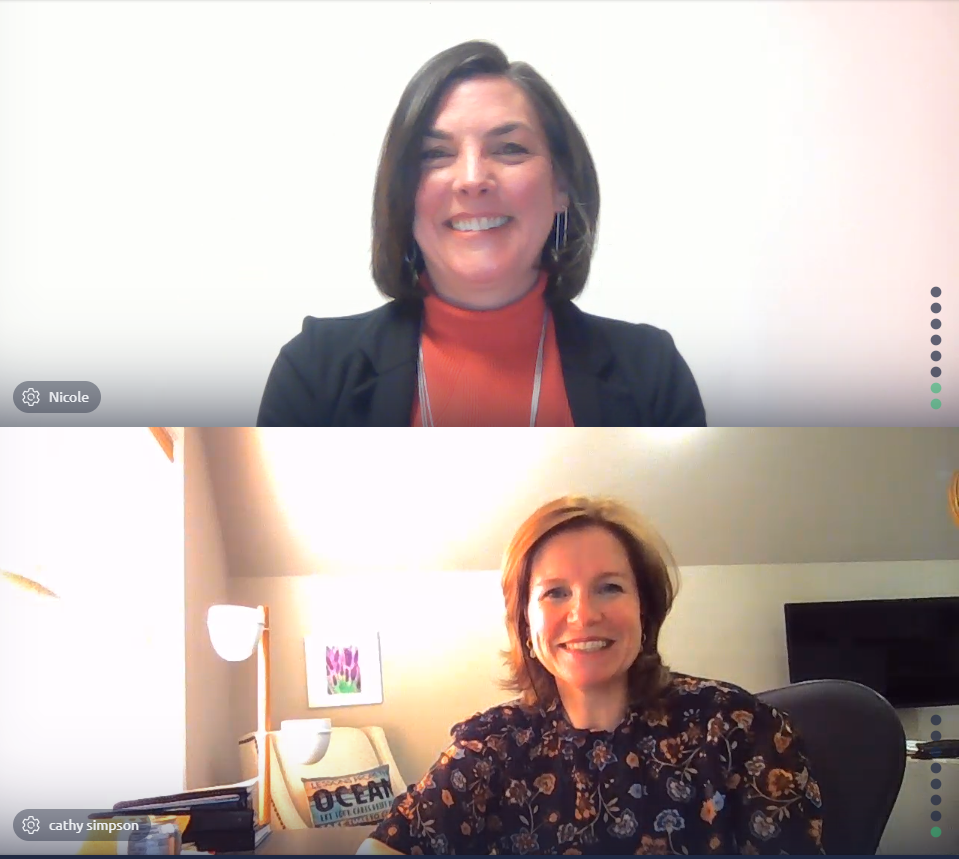
Nicole and Cathy Picture.PNG

So, what IS change management, anyway? 

"There are many different names," Nicole says, including “organization change management” and “organization change readiness.” While many people tend to think of change management in relation to IT and release management for technology projects, it can be applied to all kinds of projects, from a new computer system or office move to pivoting due to a global pandemic. There are many different kinds of clients, many kinds of changes.

Whatever the project, the change process and the principles are the same. It's about risk management, Nicole says. And that starts with a deep-dive organizational assessment.

"We tend to highlight a lot of risks at the beginning of a project, which sometimes feels to our project managers like we're slowing things down," Nicole says. "But it's really so we can put the right mitigation strategies in place to get those business results sooner and to a greater degree."

All together now!

The process is also front-end loaded with aligning the leadership team.

"Most leaders will tell us, 'Well, we're aligned,'" Nicole says. But with a bit of probing, it becomes clear that's not necessarily the case. And that's OK. The idea is to understand this at the outset and tackle it as a risk. Leaders have to go through a change process, too.

"Without that leader alignment, it's very difficult to support individuals through their discomfort,” Nicole says. "And that's OK because you can't have any change without discomfort, which is why change is so hard. So we need to be able to support our leaders through this process."

What change management is NOT.

Nicole sometimes sees companies make the mistake of thinking that change management is about making your staff feel good.

 "It's not about being nice," she says. "It's about building capability, strategy and leadership."

And many organizations have a limited sense of the scope of change management, which goes beyond a new piece of software, say, to span organizational change, processes, and preparing people for the change. It isn't just a little communications or training. And it needs to be woven in from the start, well before the change takes place.  

"Often, we get brought in too late, right before go-live," Nicole says.

Effective change management begins before and continues after the "flipping of the switch of the change," smoothing the way for the transition, getting people and processes in place to mitigate against the inevitable productivity dip, maximizing the investment.  

"When you actually do the metrics after the fact, and you look at the performance, people don't always know how to use the system to its full capacity, so you don't get the benefits."

Partners in the project.

Nicole favours an integrated approach between project management and change management, always aligning change management to the business case, with strategies and approaches tailored to the organization's particular aims and needs.

"Every change is going to feel different, depending on the organization and the people and the culture,” she says. “And so that's really where the magic happens."

Increasingly, Nicole sees internal change management roles, a change she applauds and that she and her colleagues at Mariner support in their work.

"You want to leverage external consultants to some degree," she says. "But having your own internal capability is critically important to build that capacity over time and to build the resilience of your leaders."

Change management professionals show up in different places in an organization, from HR to a separate, standalone department or office. And there are many paths to change management, from business to psychology to communications. Along with an appreciation for process and at least a bit of data chops, a  key trait is what Nicole calls "interpersonal flexibility" and a learning mindset because every project, every client is different.

"It never gets boring," she says, “that challenge of really supporting people through this process, and helping people realize that it's OK to feel uncomfortable.”

Nicole is a huge fan of process, "which a lot of people are surprised by," she says, "because they think I'm a people person. But it's really the process that I'm in love with."

Check out our entire conversation by clicking here to listen.

And here are some of the highlights from this episode:

>>[08:44]: Nicole unpacks some of the high-level confusion around change management.

>>[17:00]: Nicole talks about getting leaders to see change management as a business enabler.

>>[26:00]: We dive deep into alignment and why it's essential to change management.

>>[29:00]: Nicole unpacks the communications component.

>>[34:25]: A common question, answered: where is the best place for change management to live in an organization?

>>[42:05]: Nicole on the many paths into change management and critical skillsets for the job.

Don't Miss an Episode.

Do you subscribe to the TechTalks With Cathy Simpson Podcast? You should! Every week, my guests and I cover many different topics around innovation, technology and the future. Click here to listen and subscribe in iTunes. You'll find us on Spotify, Apple Podcasts, Google Podcasts, PodLink and everywhere else you enjoy podcasts.

And sign up for our newsletter to never miss an update.

The Power of Data

Untitled design (6).png

There’s more data than ever, and this week TechTalks delves into its scope, power and opportunities.

This episode continues our experimentation with taking the podcast outside the studio and into the community through webinars and other events. This show is adapted from a panel that I moderated on March 12 as part of the 2021 Virtual Data Challenge at UNB. The virtual event drew 38 teams from eight countries and five Canadian provinces who used data to tell stories and provide recommendations.

On this episode, I talks to three panellists working on transformational data products and projects about their career paths and perspectives on how data can advance ideas, support better, quicker decisions and build better products. Their range of backgrounds and experiences show that there are many fascinating paths to a data-driven career.

Justin Kamerman.jpg

I’ve known Justin for about 15 years and we worked together at T4G for a short while.  In his more than 20-year career in data architecture and data science, Justin’s seen the evolution of data’s relationship to product, powered by new tools and ever-cheaper computing power. 

“Ten years ago, your product was largely driven by what was possible technologically,” he says. “Now, you're taking data and turning it into something else. There are two parallel streams: you have to build out the tech, but you also have to make sure that the data supports your hypothesis, which gives you a product.”

Justin’s path to data came through software, working with applications that evolved, over time, from simple functions to those that use data to make decisions.

“I feel like my software skills really dovetailed well into the more quantitative side of things,” says Justin, who upskilled his mechanical engineering background with graduate degrees in computer science and mathematics from UNB. 

“Because all the tools used in the industry have come from the software side, it's a great complement to put those skills together.”

Today, he leads Instnt's product and engineering groups, where he’s responsible for the definition and delivery of the product and platform roadmap.

The New York-based SaaS company works in fraud risk detection and identity verification, using nontraditional data to help groups such as immigrants and millennials access credit while indemnifying banks’ risk. It’s a turnkey software service.

“You just drop some code on your webpage, and that routes it through our system,” Justin says. “It's a lot of engineering because it’s all real-time.”

Justin sees a shift in data from it being strictly the realm of data scientists who know the tech and tool to more domain knowledge coming to the fore.

“Sure, we have this massive IoT stack that can handle a million streaming events per second; that’s wonderful,” Justin says. “But if the data doesn't support you being able to use that to make quality decisions, then it's just going to sit there. It’s not going to be valuable.”

Susan Hunt, Chief Technology Officer, The Oceans Supercluster

Susan Hunt.jpg

Susan Hunt’s work has always been out to sea.

“I've done a bunch of different gigs, all primarily in the ocean space around innovation or product development or the management of the same,” she says.

A naval architect by training, she cut her teeth as a designer at Brunswick, the world’s largest boat designer and manufacturer, using data and mathematics to create blueprints for massive vessels.

“It’s one instance of how data gets visualized to create a product,” she says.

Susan also used data to test and refine the final product, spending thousands of hours on the water troubleshooting boat parts and systems.

“You get huge amounts of data coming in from the various types of equipment and sensors to help understand how a product is working,” she says. “So data is also really important to product development and commercialization.”

Susan, who has a graduate degree in information systems, has also seen data integrated across departments and databases for very high-level decision-making that transcends a single project or product.

“With that much data, you’re taking it up a step, you’re getting into a systems-level understanding,” she says. “You're getting to the point that you're using it to make decisions on not just a product level but at a portfolio level. What are the types of products we want to build, how are we working as a company together, how does our team need to be restructured to be more efficient?”

Her role as Canada’s Ocean Supercluster Chief Technology Officer builds on her subsequent experience in Atlantic Canada’s tech and research sectors. The organization is a collection of hundreds of companies and public sector organizations that collaborate on projects to improve Canada's competitiveness and productivity in the ocean space. To work together, they had to find common ground and challenges.

“The number one common denominator across different ocean sectors was lack of high-quality, real-time data,” Susan says. “It was the glue that actually bound companies and organizations from different sectors together around such a game-changing movement in Canada's ocean space.”

Jason Lee, Partner, MNP

Jason Lee.jpg

Jason’s applied data group at MNP has a mantra: “Make better decisions and improve operations using data.”

That sounds simple enough, but it plays out in a wide range of ways, from advanced predictive analytics, artificial intelligence, machine learning, modelling, visualizations, and even data strategy and governance.

Often, they work in partnership with large tech companies to find solutions for customers, including Microsoft, with whom they’re a Gold Certified Data Partner.

“Partnering with someone like Microsoft is really an extension of your sales arm,” Jason says.

As one of the largest full-service business advisory firms in Canada, MNP’s projects span a dizzying range of sectors and take many forms. It means working with NHL and Olympic figure skaters to build an app powered by AI and data for grassroots talent development in Canada and beyond. Or taking a cue from Toyota on more efficient manufacturing.

“It’s starting to use all the sensor data from the assembly floor to swap out machinery and equipment at the right time, so that you wouldn't have this downtime on some of these machines”

More recently, he worked on the Digital Supercluster COVID-19 Program, which leverages data and predictive modelling to help businesses, emergency responders and policy leaders to make data-driven decisions.

And Jason says he increasingly sees how data comes into play in non-traditional departments, such as marketing.

“I've never really thought of marketing as a hard science,” Jason says. But that team uses tools such as Google Analytics for search engine optimization, and A/B testing for campaigns. It’s a great example of using data to solve real business problems, instead of what he calls “science fair projects,” where the data scientists present exciting numbers or models, but there’s no plan for implementation.

“How do I take this and actually apply it, and commercialize it, and monetize it, right?” Jason says. “Because that's what companies are going to be really interested in.”

 ======

Hear Cathy’s complete discussion with Justin, Susan and Jason by watching the panel discussion or listening to the podcast.

Digital Transformation Primer

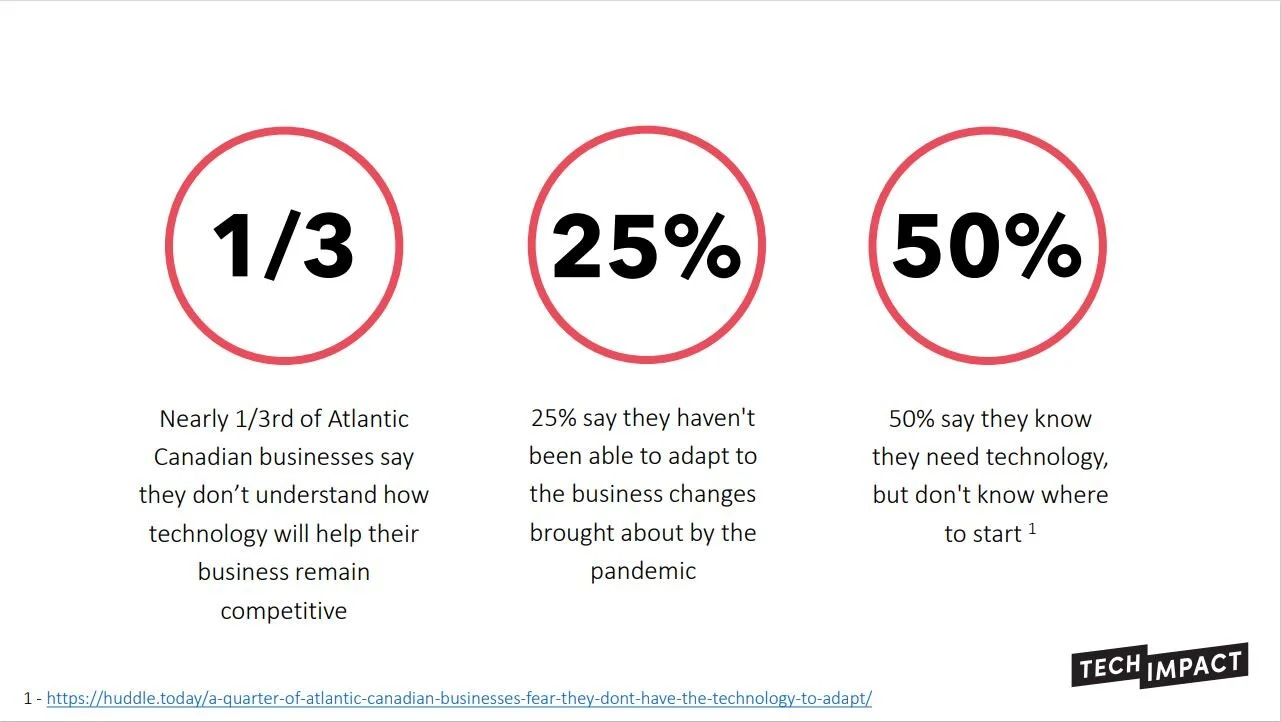
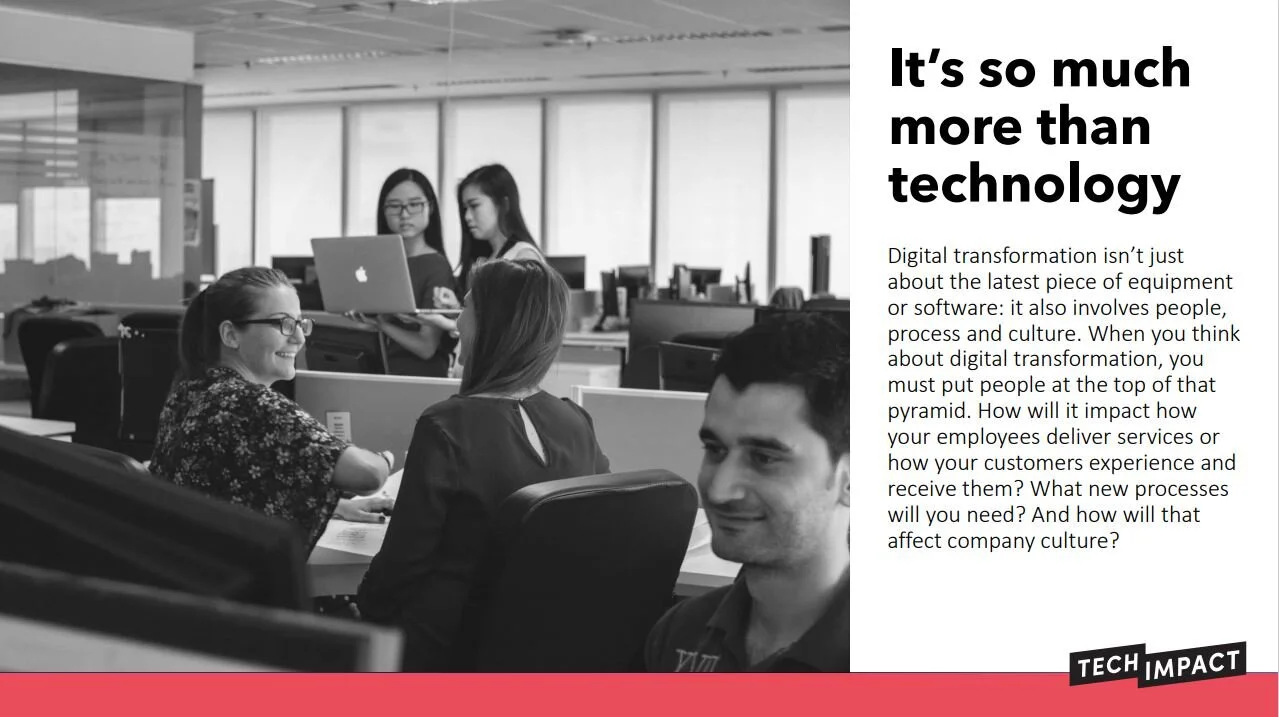
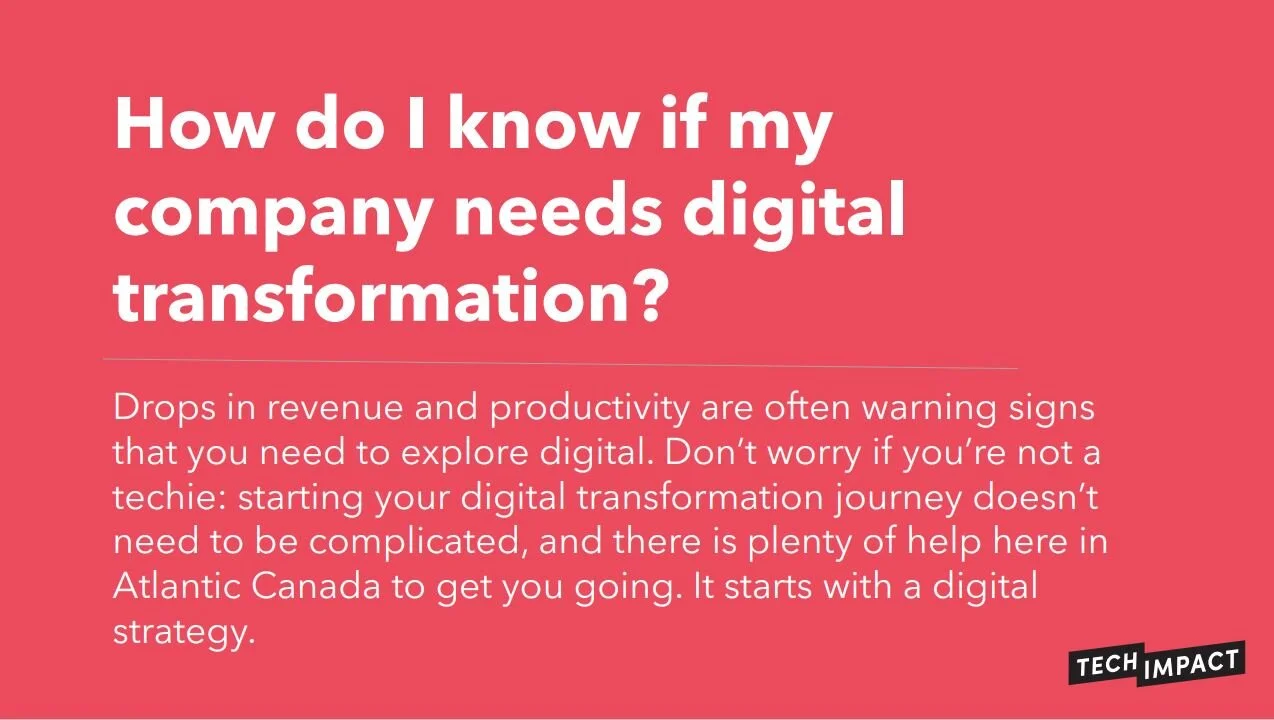
For many businesses, things like AI, robotics and even e-commerce are intimidating. They may not know what it means, how it might apply to them, what a project might cost, or even what the business value is.

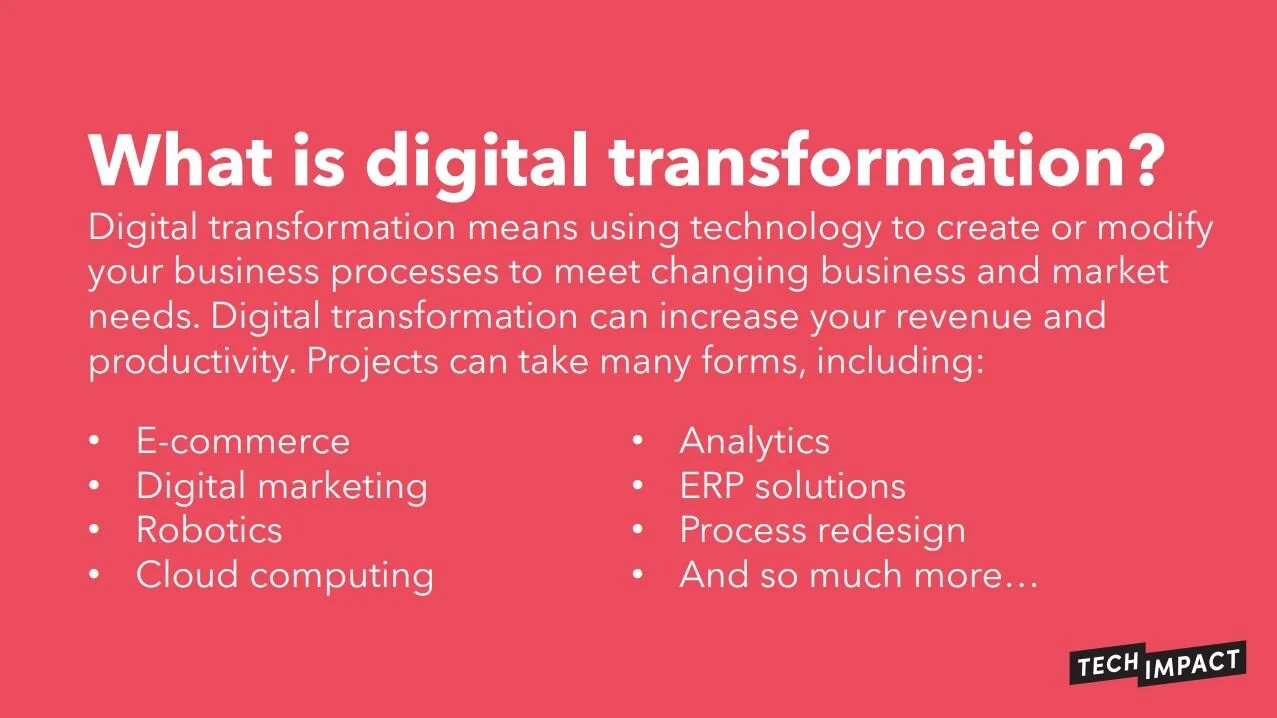
Those fears are common but unfounded. Digital transformation simply means harnessing automation and digitization to be more efficient, competitive, productive and profitable. And you don’t need to do it alone. 

Here in Atlantic Canada, there’s a wealth of expertise and a long list of service providers with the technical knowledge and business acumen to help all kinds of companies, including traditional industries or non-technical ones, start shifting to digital. 

Webinar host, Cathy Simpson.

Webinar host, Cathy Simpson.

Webinar guest, Jarvis Spires from SMET Monuments

Webinar guest, Jarvis Spires from SMET Monuments

Webinar guest, Paul Harrell from Ganong

Webinar guest, Paul Harrell from Ganong

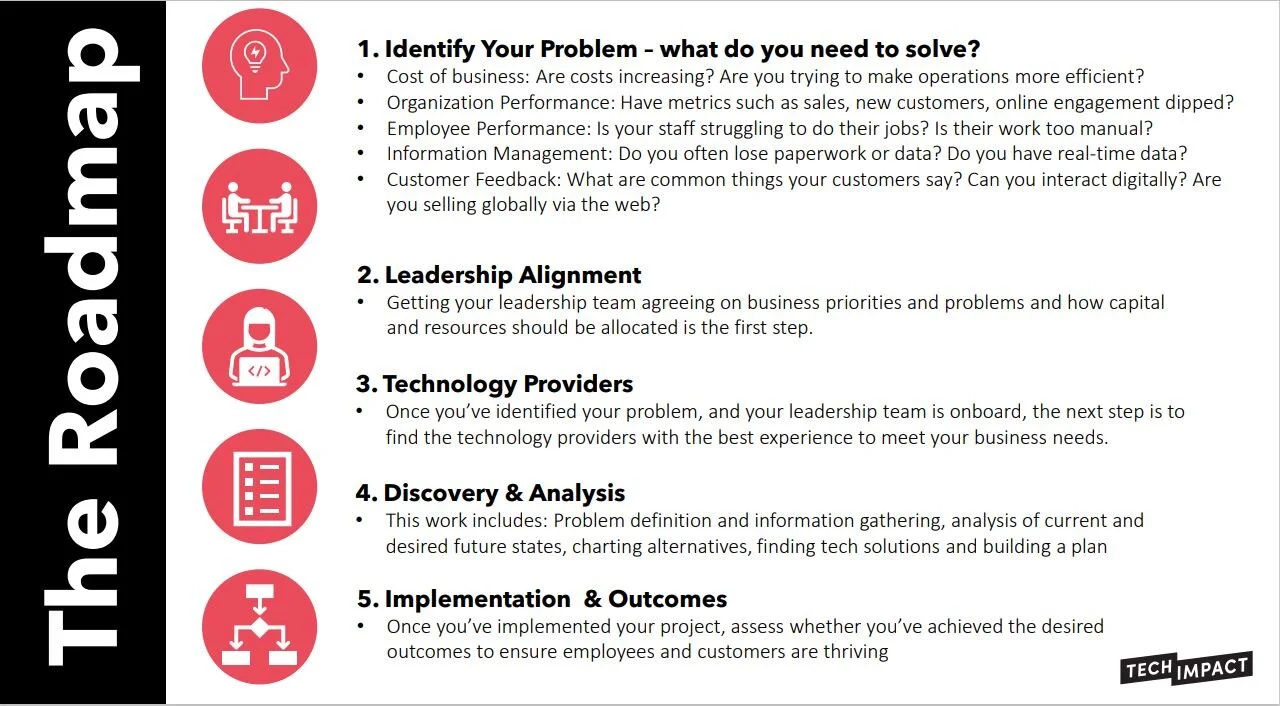
This week’s TechTalks Podcast is adapted from a recent webinar host Cathy Simpson gave on digital transformation. She breaks it down into simple steps and talks about Digital Boost, a TechImpact program that’s had great success pairing local companies with N.B.-based technology service providers on digital projects. In the last part of the show, she invites representatives from two Digital Boost projects to share their experiences. 

Get the full story by watching the webinar, listening to the podcast or checking out this Digital Transformation Primer to get started.  

DP1.JPG
dp2.JPG
dp3.JPG
dp4 - 2.JPG
db5.JPG
dp6.JPG
dp7.JPG
db 8 - 2.JPG
dp9.JPG